Gregor Mendel
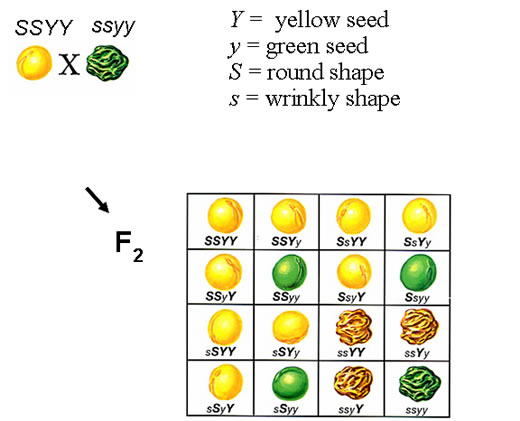
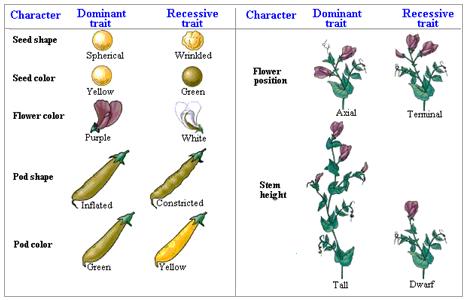
independent assortment-Mendel performed dihybrid crosses in plants that were true-breeding for two traits. For example, a plant that had green pod color and yellow seed color was cross-pollinated with a plant that had yellow pod color and green seeds. In this cross, the traits for green pod color (GG) and yellow seed color (YY) are dominant. Yellow pod color (gg) and green seed color (yy) are recessive. The resulting offspring in F1 generations were all heterozygous for green pod color and yellow seeds (GgYy). law of segregation-Mendel worked with pea plants and selected seven traits to study that each occurred in two different forms. For instance, one trait he studied was pod color. Some pea plants have green pods and others have yellow pods. Since pea plants are capable of self fertilization, Mendel was able to produce true-breeding plants. A true-breeding yellow-pod plant for example would only produce yellow-pod offspring. Mendel then began to experiment to find out what would happen if he cross-pollinated a true-breeding yellow pod plant with a true-breeding green pod plant. He referred to the two parental plants as the parental generation (P generation) and the resulting offspring were called the first filial or F1 generations. |
||
 |
 Key Terms: Genotype-the genetic makeup of an organism or group of organisms with reference to a single trait, set of traits, or an entire complex of traits. Phenotype-the appearance of an organism resulting from the interaction of the genotype and the environment. Dominant-the one of a pair of alternative alleles that masks the effect of the other when both are present in the same cell or organism. Recessive-that one of a pair of alternative alleles whose effect is masked by the activity of the second when both are present in the same cell or organism. Homozygous-having identical pairs of genes for any given pair of hereditary characteristics. Heterozygous-having dissimilar pairs of genes for any hereditary characteristic. |
|
